Anger Entertainment

In years to come, thoughtful, truth-seeking people will say “Thank God for Dominion Voting Systems.” Of course, many are saying it now, thanks to Dominion’s defamation lawsuit against Fox News (“News”, in this instance, being a contradiction in terms). Murdoch’s testimony, so far, has made it abundantly clear what the majority of people knew all along: the 2020 election was both free and fair, there was no evidence of the election having been stolen, and that Murdoch and many talking heads at Fox knew these things to be true all along.

So what has Fox News been broadcasting other than “anger entertainment,” aimed, not just at Trump supporters, but particularly at angry, white voters who fear: a “deep state,” peoples of colour, liberals, and anything “foreign”. In fact, all Fox has done is to stoke the fires of anger in these people for years, making them want to attack the nation’s capitol, its defenders, and their neighbours who think differently from them–well, actually, they are against people who think, full stop! Now that their wizards have been revealed as the frauds they are and have always been, Fox junkies will only be angrier–yet where will they vent their anger? One can only guess. And they will probably start a new conspiracy theory: that Murdoch was got at by the “deep state.” (You read it here first.)

Murdoch et al have made it abundantly clear in their texts and emails that they have promoted the Big Lie in order to receive their 30 pieces of silver–a million times over. They have knowingly promulgated lies in order to keep their ratings high and the money pouring in. Happily, they have also made the case for defamation against Dominion much easier to prove, because they knew they were disseminating lies that would be injurious to Dominion Voting Systems. Their mendacity was premeditated. They were not, as some would protest, exercising their First Amendment right. They were, in Oliver Wendell Holmes’ words “falsely shouting fire in a theatre and causing a panic,” particularly among those with the mentality which proclaims: “Where we go one, we go all.” We have seen its results on 6 January 2021.

Anger produces cortisol and, for many people, cortisol can become addictive. Fox junkies turn on their favourite “news” channel in order to supply their addiction. They remain in a permanent “fight or flight” state of mind. No wonder they want everyone to carry firearms. Last week I wrote about behaviour which is “diabolical”–a word which comes to us from the Greek, meaning to “divide” or “throw apart.” Murdoch and his employees are the living embodiment of the diabolical. They pander to humanity’s baser, more primitive instincts, and what they offer viewers can only be described as “anger entertainment.”


Trump and Minions as Διάβολοσ

If the Greek word in the title eluded you, it is transliterated as ‘Diabolos.’ You might recognise it in Spanish as “el Diablo” or “the devil” in English. Those terms might seem a bit trite to some or very appropriate to others, but I want to examine the Greek word for its significance in our lives today. Diaboblos comes from the verb Διαβάλλω, which literally means “to throw apart” or “to divide.” In both the Greek New Testament and the Hebrew Bible, the terms diabolos and satan do not refer to some evil entity who goes about doing harm. Rather, in each testament and language, the ‘devil’ or ‘satan’ is simply the one who accuses, slanders, drops a misleading word; but leaves it to gullible humanity to carry out the disastrous results: war, prejudice, persecution, violence towards those different from ourselves, etc. In today’s parlance, we are talking about the business of false news, fabricated conspiracy theories, hysteria over stolen elections, liberals “eating babies” and more. All of these things are literally “diabolical” because they divide nations, societies, families, workplaces, schools, etc.

In my 70+ years I cannot think of another leader in the Western World who has so divided the United States and NATO more than Donald Trump–and now his host of minions: Ron DeSantis, Marjorie Taylor Greene, Lauren Boebert, Fox News’ Sean Hannity, Tucker Carlson and other empty talking heads. Stalin, Krushchev, Mao Zedung and others never came close to fracturing the USA or the NATO alliance. Yet there is hardly anyone I know in the US whose life has not been affected by the fallout from Trump and his minions. People have simply stopped speaking to one another over Trumpism. Personally, I lost two long-term friends who were always more conservative than I, because I dared question their loyalty to a narcissist who not only used racist, sexist and xenophobic language, but made it seemingly okay for like-minded individuals to do the same. Sadly, my former friends were like-minded.

However, the divisiveness doesn’t end with friends and families–it divides people from their very own minds and souls. How so? One of the two men I mentioned above was also an ordained Christian minister, and very well educated. The last time we communicated, he said to me that “there is not now, nor has there ever been, institutional racism in the USA.” I couldn’t believe my ears, so off the top of my head I mentioned the “Three-fifths compromise” which is part of Article 1, Section 2, Clause 3 of the US Constitution. It held that for purposes of taxes and electoral votes, only three in every five black slaves would count towards a state’s population. It’s been in the Constitution since 1787. Then I mentioned the Civil War, the Emancipation Proclamation and the Thirteenth Amendment (abolishing chattel slavery)–can you get more “institutional” than these examples? This is what I mean by the diabolical nature of Trump & co. People are divided from their “better angels,” from the facts they know to be true about American history and the Constitution; they are divided from what–at some level–they know to be good, right and true. Why? Because they are divided souls. They are divided from the common humanity shared by every human being on the planet. And these internal divisions keep multiplying–and we witness their effects in the news every day.

For the record, I do not believe in a horned devil carrying off people with a pitchfork. But do I believe in the power of the diabolic?–absolutely! We are confronted by its choices every single day of our lives.

The CURSE of the Were Clergy!

Okay…the title and photo were gimmicks to grab your attention. And yes, the picture is from “The Curse of the Were Rabbit”, so my apologies to the Rev. Clement Hedges.

In many ways this is a postscript to my previous blog on the church being the problem with Christianity. Integral to that problem are, of course, the women and men who are ordained and paid by the church. I was one of those for decades, so I have earned the right to speak my mind. Some years ago I was a facilitator for the Regional Training Partnership in the East of England. This included the Cambridge Theological Federation which encompassed most of the Christian denominational training colleges: Catholic, Orthodox, Church of England, Methodist and more. The Partnership was to help oversee the training needs of the churches for both lay and ordained. Amongst other things, we kept the numbers of trainees, costs, etc.

And then came the day when, as we were considering training expenses and attendant costs for clergy in all of the denominations, the figures leapt off the page and, as a character in one of my novels might have said: “Whupped me upside the head.” What struck me was the hard fact that most of the churches’ money went to what I have come to call “the care and feeding of clergy.” Lay people barely got a look in as regards money spent for their benefit, spiritual development and discipleship. Well over 90% of funds went solely to the clergy. And God bless us all, the church training colleges (re-education centres?) do their best to make us ministers of Church, Inc. The prophetic spirit is to be eschewed . And as for Mr. Jesus’ admonition to serve the “hungry, thirsty, the stranger, the naked, sick and the prisoner (Matt. 25),” well….”only after we’ve paid clergy expenses, repaired the bell tower, and new robes have been purchased for the choir,” etc.

In England, clergy collars are popularly refered to as “dog collars” and that is quite apt, for–like dogs–clergy are tamed and trained not to rock the institutional boat…or one might lose one’s “living” as the Anglicans call it. Most ministers live in vicarages or manses–church-owned houses…kennels comes to mind(!)…as well as not biting the hand that feeds you. More than once I was admonished, after a particularly prophetic sermon, that “we own your house!” In other words, “say nothing to challenge or to encourage us to become more Christ-like or you’re outta here!” After I resigned from parish ministry (I was in the United Reformed Church at the time), it was nine months before my Provincial Moderator paid me “pastoral” visit. His main concern was that if I only stuck it out another ‘so many years’, I could have a house for my retirement. Ironically, he was visiting me in a house we had taken out a mortgage to buy, so I told him that, 1) I didn’t need to wait to have a house of my own and, 2) I hadn’t gone into ministry for the promise of a house at retirement.

As I draw this blog to a close, I suppose I should have entitled it “Vampire Clergy” because, in all too many cases, we drank the life-blood of the church’s resources. Happily, many Jesus followers are coming to the realisation that while learning and education are always necessary, they do not require the institutional church, which chokes the very message it is meant to share. It is liberating to contemplate that God–the power behind the entire universe–does not need the church.

The Problem with Christianity…Is the Church

Three years ago my second novel (pictured above) was published. It took a deep dive into the problem leading to the decline of Christianity in the US, which is: the institutional church. For those ‘in the know’, this is trite, but true. Of the many things we were never taught in seminary, we were first and foremost never taught that the church itself would be our greatest problem or antagonist. Atheists and agnostics generally ignore organised religion. But it is the church’s own adherents who both give Christianity a bad name and ministers a hard time: particularly IF one entered ministry with the idea that speaking the truth, behaving honestly and addressing society’s ills were essential parts of one’s calling.

However, for those who are happy to turn a blind eye to society’s failings–homelessness, gun worship, sexism, racism, etc–then one can enjoy a fairly good living; or, if one is totally without scruples, one can amass enormous wealth. All one has to do is suck up to the monied people in one’s congregation, glad-hand the others, massage everyone’s frontal lobes with bland sermons and there you have it! All God’s children got shoes.

Let me share a non-exhaustive list of things I have personally encountered within the church over the forty years I served: child abuse in a church’s daycare centre, embezzlement of church funds well into 6 figures, defrauding state social services–all three of these were ignored by those in higher authority. After blowing the whistle on the aforementioned activities, I received death threats and abusive phone calls, and the denominational authorities tried to implicate me in the very things I reported to the police. Our family had to go into hiding. We lost our income, home and health insurance. The institutional church wiped its hands of me and went about its business of not taking Jesus and his teachings too seriously, as it’s too damned inconvenient.

How about personal issues? The Sunday morning after my first child was born, I arrived at the service to announce the birth of my daughter and the name she had been given: Jessica. I was immediately cuffed by a thoughtless individual who told me why she hated the name my wife and I had chosen. So much for one of the happiest days of my life. (The same happened again after our second child was born…at least they were consistent.) When my daughter was two, a parishoner rang late one afternoon and said she needed to see me urgently. I replied that I was preparing a meal for my daughter and that my wife wasn’t home. No joy. She still had to see me right away. I replied I would come, but would have to bring Jessica with me. “Must you?” came the petulant reply. I then had to explain why leaving a two-year-old alone was not a good idea. As my children grew, they had the fun of having people come to the house to complain to me, one of whom used to erupt into a rage of screaming and shouting. (They will know we are Christians by our love…eh?)

Of course, my experiences pale when viewed in the light of the Roman Catholic Church’s sex abuse scandals and when compared to America’s love-affair with the gospel of prosperity as propounded by TV evangelists. But, hey, they are my experiences and I have had to learn how to both cope and forget. Attitude really is everything. We really do have choices as to how we respond. And thus, while it might puzzle or surprise some of you, I remain a Christian…of sorts; or perhaps I should say, I remain a Christ-follower. I am not responsible for the ills done to me and my family–thank God. My spirituality has deepened since leaving the institutional church. My wife and I now attend a Christian “fellowship”, we practise contemplative prayer, and we continue to live out our values in our dealings with others–ironically, something I found so hard to do in the instutional church.

I Talk to Animals…They Communicate with Me

My mother liked to recall how, when I was in first grade, I received a low mark on a “test” because I was supposed to put a tick by pictures of animals that could talk. I, of course, ticked all living animals. The “correct” answers were supposed to be only human animals: the guy with the hat and pipe, the little girl with the puppy, etc. Happily I knew better than that both then and now!

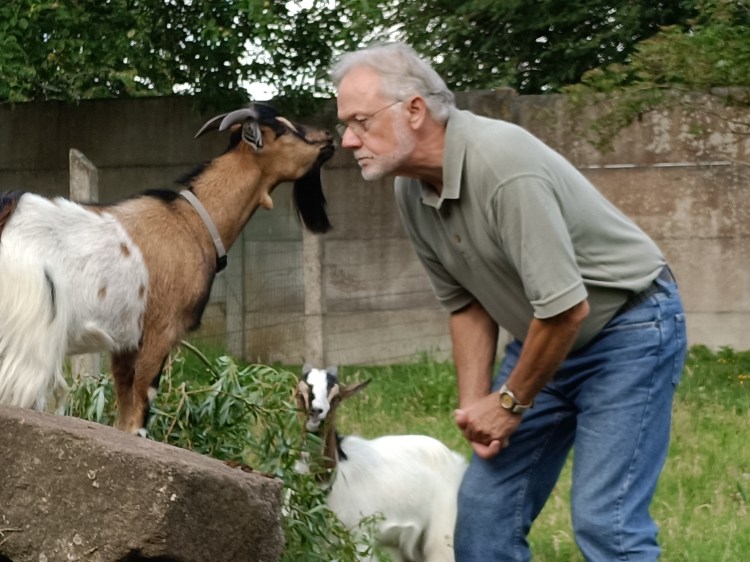
In the picture above you will see me having a heart-to-heart…or perhaps nose-to-nose with Bullwinkle. That’s Rocky in the background. They are chevres nains or “pygmy goats.” I prattle away to the boys every day–particularly at feeding times. That’s when I do most of the talking. However, it is when I simply take time to be with the goats that they really communicate with me. They each have different needs which they communicate in their own unique ways. For example, Bullwinkle likes to use my back to reach leaves and fruit which are out of his reach. (At the withers, both goats come to my knees.) Whenever Bully wants to hop aboard, he taps me with one hoof. Once on my back he taps when he wants me to move–usually towards lush greenery. He continues tapping until he can reach his desired food. What about Rocky? I hear you ask. Rocky uses various head tosses or positions to indicate where he wants to be scratched: a dipped head means “between the horns, please.” (They have been taught their manners.) Head back means neck and back scratch. Head cocked to one side means chin, beard and flank strokes. They communicate all this and more without one word. All animals can communicate and most humans can understand if they take the time to watch and observe. (I had a budgerigar who loved Ray Charles!–especially “Baby What’d I Say?” People refused to believe it until they saw it for themselves.)

Humans are slowly–albeit reluctantly–discovering that we are not the only creatures with consciousness and the ability to communicate. And when it comes to animals using ‘tools’–have you seen videos on Facebook or YouTube lately? We continue to be surprised when animals do acts of kindness or actions that we consider “human.” Animals haven’t changed, but our human-centric view of the world is beginning to change.

I learned decades ago that if I went into the woods and sat still for at least 30-40 minutes, various forest denizens would come check me out: squirrels, raccoons, deer, etc. Deer, for instance, usually come within 2-3 metres, then stamp the ground and snort a bit. When I remain still, they then come to have a good sniff. Once satisfied that I mean them no harm, they go about their business. This has happened numerous times in different countries. And, of course, via the Internet one can find more incredible stories of human/animal encounters than mine. But the rub for greedy humanity is that, as we come to recognise that other animals are sentient, it challenges us to treat them differently. They aren’t in existence just to be killed for our pleasure. Hell, many of my fellow white people have a hard enough time accepting multi-coloured humanity as sentient and deserving of their acceptance!

Well…maybe Mrs. Stroup was right in giving me a low mark for saying animals could “talk” like us humans. But one thing is patently clear: all animals can certainly communicate if we only use our God-given senses to take notice.

Conversations which Alter our Perception

There was a comedy team fifty years ago which put out an album entitled “Everything You Know Is Wrong.” Have you ever had such a moment (or moments) in your life wherein that seemed to be the case? Perhaps everything you knew wasn’t wrong, but you had your eyes/mind opened to the fact that you were completely wrong about something or someone.

For me, such a revelation came the night before my brother’s wedding in 1976. I was sitting up late with my uncle Paul–my father’s youngest brother–and we were getting sloshed on gin and tonic. Paul mentioned something positive (now long forgotten) about my father’s sensitivity and I responded sardonically with something like: “You are talking about JC Lawson, my father and your brother, aren’t you?” Paul was not amused and gave me the ‘Lawson look’ before he spoke. I have never forgotten his words: “Your father is the most sensitive man I have ever known.” As the saying goes: “You could have knocked me over with a feather.”

Bit o’ background. The photo above is of my father on Okinawa in 1945. He was in VMO-7, attached to the 3rd Marine Amphibious Artillery. His group flew artillery spotting, aerial photo reconnaisance and perhaps most importantly–because of the capacity of their aircraft to take off and land in 100 metres–they evacuated badly wounded Marines. Paul, on the other hand, was too young for the war, was sophisticated, lived in Washington, DC and was gay. All I knew of my father was post-war; but Paul remembered his very sensitive older brother before he went to war. I knew my father as a tough-guy Marine, heavy smoker and drinker, with an explosive temper. That temper was the only ‘sensitive’ part of my father to which I had been exposed. One could never be sure what would set off my father’s anger. (I didn’t realize I tiptoed whenever I was indoors until I was 27.)

Paul was talented, an amateur actor with a fine singing voice, knew fascinating people and threw great dinner parties. I loved going up to DC to stay with him. So you can imagine my reaction when he described my father as the most sensitive man he had ever known. In truth, it wasn’t a case of everything I knew about my dad was wrong; I just didn’t know enough. I had pigeon-holed him. Having never been to war, suffered kamikaze attacks or evacuated the bloodied, broken bodies of my fellow Marines, I couldn’t know firsthand what happens to a very sensitive young man in a savage war.

Thus began a journey of father-discovery, as well as self-discovery in psychotherapy. I was a prison chaplain at the time and worked with a lot of Vietnam vets. It became clear to me that pain, suffering and grief–if not dealt with openly and honestly at the right time, come out as anger or violence at the wrong or inappropriate time. We can train our military to fight and kill, but we can never train them not to feel anything when they see their comrades die or they take the lives of others. Those emotions go deep inside, but they will eventually come out. We now know it as PTSD.

It was three years after my conversation with Paul that my father and I finally ‘met.’ I had decided to visit my parents and spend some time with dad. We went out for a few beers, but when we arrived back at my parents’ house, dad made no move to get out of the car. I remember the emotions more than what was said that night. As we opened up with each other, all the sensivity that my father had suppressed–since the war and since becoming a father–came out in a flood of tears. I was almost in shock as I held dad in my arms while he wept on my shoulder. I learned that his fear of showing his emotions appropriately had been rooted in the fear of not being able to ‘control himself’ once they started to come out. I don’t know how long we stayed in the car; but it was long enough to alter my perception of my father forever. Dad died 36 years ago. The last time I saw my uncle Paul, I thanked him once more for giving me the chance to alter my perception and come to know my father.

Of Mind Trash and Human Prejudice

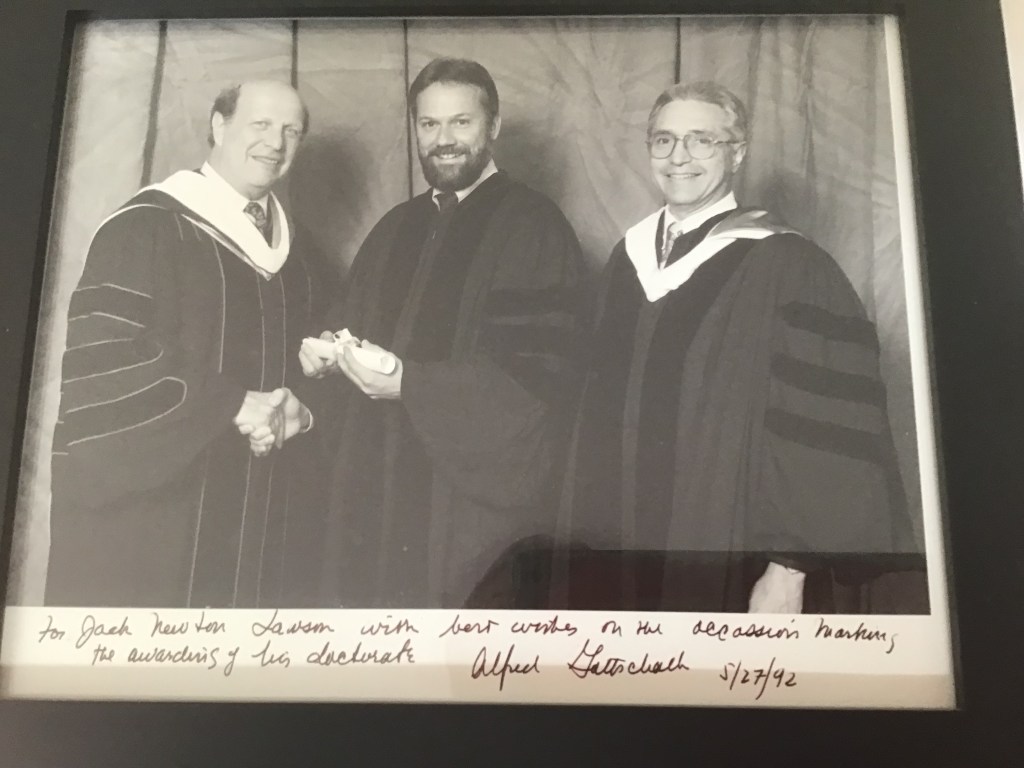
A year or two ago I wrote a blog about ‘whitespeak’–the coded language that white Americans use concerning peoples of colour when they want to see if you (should you happen to be white) are ‘on their side.’ Today I want to reflect on a similar language of prejudice, but in England. In the above picture–of a photo on my study wall–you’ll see a much younger me receiving my PhD at Hebrew Union College-Jewish Institute of Religion (hereafter HUC). It was a defining moment in more ways than one. Yes, the degree marked the successful end of years of study and research, and my thesis was published as a book; yet little did I know at the time that it would be one of the most detrimental aspects of my academic career. Let me explain.

I had applied and been accepted at several prestigious universities to do my doctoral work. All had offered partial scholarships, but HUC offered me ‘the full ride.’ That was important for a poor prison chaplain. It was also the case that HUC’s school of graduate studies had a “Christian Fellows Program” which admitted 5-6 Christian doctoral students each year on fellowships. The graduate program was conceived after the Second World War as a way to foster Jewish-Christian dialogue. That interested me. So it was not your average PhD program. All well and good…but then came my job search in England…and my introduction to Gentile-speak, for I had been tainted by Jews!

Forget that I had attended an institution with the largest Judaica collection outside of Israel, and could sight-read Hebrew, Aramaic, Akkadian and a fist-full of other languages. Although that in itself was a threat to many English academics, the clincher was I had studies with Jews. And so followed a number of unsuccessful interviews in which the sticking point was always, and I quote, “Hebrew…Union…College…bit esoteric that.” That exact phrase was used at different universities; often by a member of staff who was also an Anglican clergyman. Being something of an idealist I wasn’t prepared for such outright prejudice. Although no one, of course, resorted to calling Jews ‘kikes’ or ‘yids,’ the whole tone of the interviews changed. There I was thinking that universities wanted teachers well-versed in the languages and cultures they were meant to teach, but I had, as it were, ‘gone native.’

Let’s consider Cambridge. After the code-phrase “bit esoteric that” had been spoken–and I knew the interview was a lost cause–I noticed at eye-level, on the shelf behind me, The New English Bible (NEB), Oxford Study Edition. (In this instance, “English” is not a reference to language per se, but ethnicity.) As all prejudice is born of ignorance, I embarked on a suicidal bit of education for my interlocutors. To their surprise I pulled the NEB off the shelf and in the same ponderous monotone as “bit esoteric that” I said “New…English…Bible.” Then I turned to the editorial page and read out: “Samuel Sandmel, general editor of the New English Bible, Hebrew Union College, Sheldon Blank, HUC, David Weisberg (my PhD advisor), HUC, etc. In sum, there were more scholars from HUC on the editorial and contributors list of the NEB than from any other university in the world. For some reason, my efforts to enlighten the interview panel failed miserably, and I went away jobless, hurt and very angry.

Why do I share this experience? (It is not sour grapes, as one might be tempted to think. Read on.) Two reasons: First, despite the Second World War and the Holocaust, anti-Jewish prejudice is alive and well–across Europe and the USA. In my experience, Gentile Hebrew Bible scholars are amongst the most rabid opponents of the state of Israel, and by extension, of Jews in general. Before my wife and I left England in 2016, anti-Jewish hate crimes had increased by over 2000% since the year 2000. Just like racial prejudice in the US, these ‘pet hates’ have only simmered in the background until the social/political climate was right to express them once more. That’s scary–and it must be exposed and confronted. Second: As I prepare myself for the inevitable, death, I am doing my best to leave old baggage behind (see my blog of a similar title from a few weeks ago). Some of this I do by writing, some through meditation, some by blessed forgetfulness(!) and some by simply ‘letting go’ as I focus on my newfound profession as goatherd. With hindsight (the blessing of longevity!), I am glad I was not appointed to several of the posts I sought so fervently years ago. In fact, I find it funny now. But what I don’t find funny is deeply engrained prejudice against our fellow human beings–of whatever colour or persuasion; for that is the Covid of the human spirit. We need to be putting as much effort into the fight against prejudice as we do in our fight against viruses.

The Art of Pure Being

In writing this piece, I am standing on the shoulders of Jesus, Buddha, Meister Eckhart, Rumi and a host of other spiritual teachers and philosophers over the past millenia. This is simply my take on a subject which affects all of us–but only if we give it some thought…or perhaps some pure being!

Most of us start out as children. I say most of us because a significant minority have gone through the ages of childhood without actually having lived as a child. And, sadly, some in this world of ours are denied childhood due to warfare, famine, poverty, etc. Having a good childhood is important because it is our introduction to the art of pure being: no pretense, no shame, no need to have ‘all of the answers.’ It is a time of wonderment, imagination, being the hero in our stories, and more.

We recently had the pleasure of keeping our neighbours’ 8 year old son for a week. When we watched “The Wizard of Oz” together, he was in the story. When we took him walking in a nearby forest, we were inducted into his world of make-believe which, as Bruno Bettelheim has pointed out, is important work for children. Some adults are lucky enough to have jobs that allow them to keep the child in them alive: artists, writers, playgroup leaders, etc. And I stress that this is not some sort of Peter Pan existence. It is simply giving our right-brain as much time as our left hemisphere. To use the cliché, it’s about living as a human being as opposed to a human doing. When our young guest was at play, he wasn’t constantly looking over his shoulder to see if anyone was watching or worrying about what someone might think. That is pure being. Numerous saints, Zen masters, mystics and artists live into the art of pure being. It is also where joy resides. And joy is the lifeblood of being.

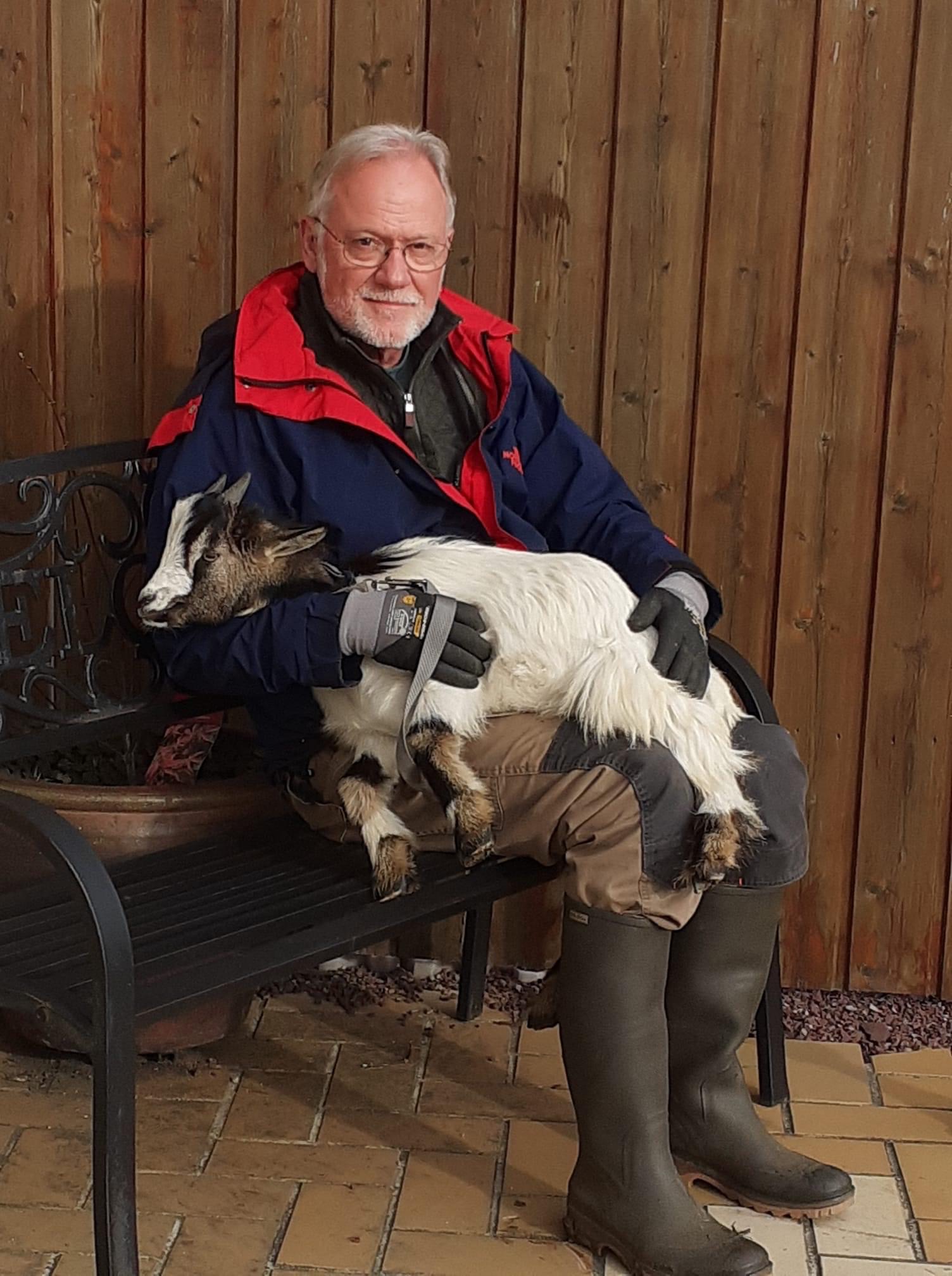
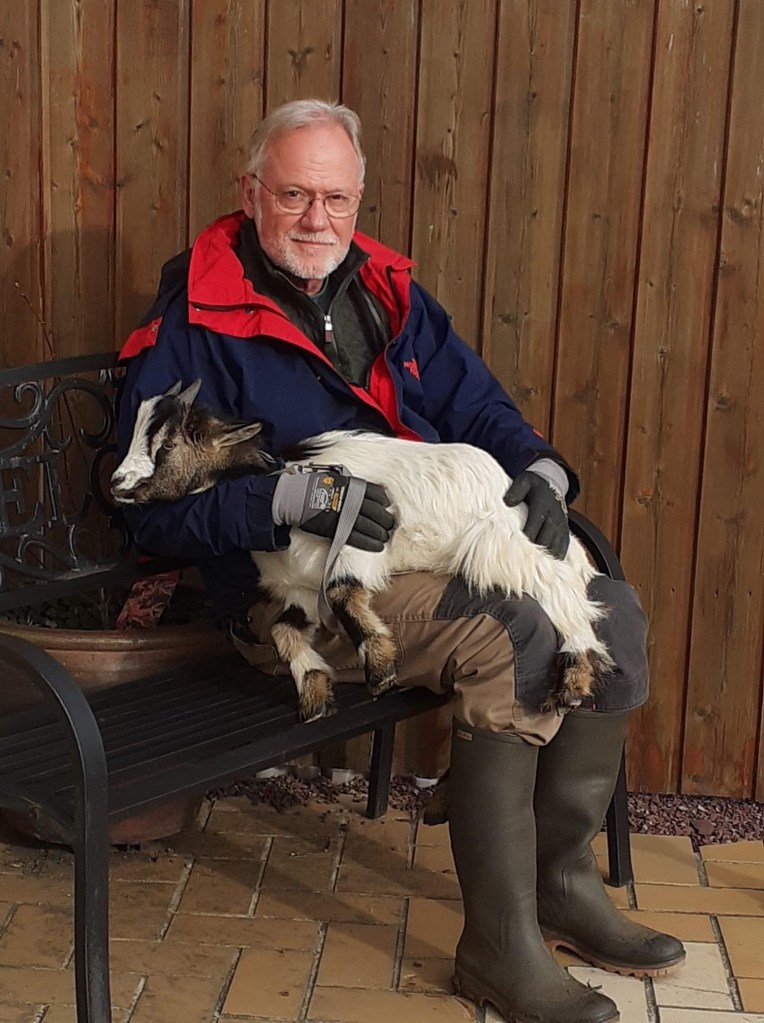
For my part I also have important teachers in our goats. All my life I have found more pleasure in being with animals than with my average human counterparts. Animals live in a state of pure being–and they can share that with us–if we will only give the necessary time to be with them–and listen and watch. As I look back over my life and career, I find that being a goatherd is by far more enjoyable than being a university lecturer, parish minister or commmunity development worker–roles in which everyone had an idea of what and how I was supposed to be–particularly as a minister (a role which seems to invite projection of all sorts–mainly negative)! Like their fellow four-footed creatures, goats use a variety of bleats, eye contact, nudges, head movements, etc. to communicate. And dare I say they are even responsive to mindfulness(!). But that first requires that I must be present and mindful. Some people who see my goat posts on Facebook respond that the goats are probably training me as much as I am them…well yeah! It’s a relationship; and in that regard it’s no different than roommates or spouses learning to live together. We have to learn and adjust to one another’s peculiarities.

Mr. Jesus said that if we want to enter the kingdom of heaven we must turn and become as little children. Amen (or Ba-a-a!) to that! Children (and goats) live in the only existential, real time: now. If we had a good start with our childhood years and–if we’re mindful enough–we might just be lucky enough to live into the ‘second childhood’ promised by old age. But why wait, why not start now?

The Pace of Change

Yesterday, as I was listening to BBC Radio 4, I heard a very cogent argument for going on personal retreat. For myself, I need no argument for taking retreats, as I have done so numerous times. But one only need get behind the wheel, join a queue in a supermarket or visit a busy restaurant at lunchtime, and you will certainly see many people who would benefit from a retreat–if only for a few days. It should also be stated that retreats need not be faith-based.

Alongside the notion of retreat, I started musing about today’s pace of change, which is largely driven by technology. Had we lived a thousand years ago, we probably would have lived our entire lives without one significant change in technology as regards its impact on individual lives. Today, with our many mobile devices, we are never out of touch with family, friends, work, robo-calls, etc. News flashes tell us of tragedies half-a-world away, within minutes of their happening. There is more information in the Sunday Times (NY or London–you choose!) than the average literate person would have read in an entire lifetime in the Middle Ages. However, our brains are relatively the same size and our nervous sytems haven’t changed significantly. Computers double in speed roughly every four months–but not our nervous systems! Go to any decent bookshop and look at the number of self-help and how to manage stress books. It’s a growth industry.

I can still remember when my paternal grandfather took a car journey with our family on an interstate highway for the first time. He was totally flummoxed by the idea of all cars going in the same direction in both lanes! When he stepped into our new home, he felt something soft underfoot and checked the bottoms of both shoes–he had mistaken wall-to-wall carpet for cow dung! Grandpa had been born within a year of Custer’s defeat at the Little Bighorn and the British debacle with the Zulus in South Africa. He died a year and a bit after humanity set foot on the moon. In between came motor cars, telephones, air travel, two world wars, computers and more. No wonder he was happy to stay on the farm and not venture out! I saw similar reactions when I worked as a chaplain in a pre-release prison unit. All of the men had spent upwards of 25 years removed from society. It’s not surpising that so many committed infractions in order to go back ‘inside.’ They were literally ‘out of time.’

Check out these words by Anselm of Canterbury (1033-1109) from 9 centuries ago: “Flee for a while from your tasks, hide yourself for a little space from the turmoil of your thoughts. Come, cast aside your burdensome cares, and put aside your laborious  pursuits. For a little while give your time to God, and rest in him for a little while. Enter into the inner chamber of your mind, shut out all things save God and whatever may aid you in seeking God; and having barred the door of your chamber, seek him.” I am not sure what sorts of stresses people had in the 11th/12th centuries, but certainly it was a time when much work was literally back-breaking, medical care was minimal, and even learned clergy like Anselm lived in stone-cold (literally) monasteries with one “warming room.”

Even if the pace of change in the Middle Ages was more measured than what we experience today, it is clear from Anselm’s words that all of us could benefit by taking time out from the drivenness of life. We can all benefit by taking time away from our electronic masters and re-set our minds and emotions with physical, mental and spiritual refreshment.

Leave All Baggage Behind

A couple of weeks ago my wife, Chris, and I were flying to Greece. During the safety announcements before take-off, we were told that, in the event of an emergency, we were to “leave all baggage behind.” For some reason those words made me laugh as I turned to my wife and said, “Do you think that is what we will hear when we die?”

My wife has a keen interest in Near Death Experiences (NDEs) and I have listened to the experiences of many people who have had one or more NDEs. So far, I haven’t heard anyone use the words “Leave all baggage behind,” but isn’t it the case that, when we come to breathe our last, we in fact leave all of our baggage behind? Over the last six years–which have included two trans-Atlantic moves(!)–Chris and I have done our best to leave a lot of baggage behind–literally and figuratively. Shipping one’s accumulated ‘stuff’ is expensive. We have rejoiced whenever we have been able to give to friends a cherished piece of furniture or a set of books.

Not so long ago, we completely filled our car with any number of items we had kept far too long. We took them to several brocantes in our area of Normandy but only managed to sell one thing. However, one of the owners told us of another brocante about ten kilometres from his place, so off we went. The lady who managed this other brocante told me that she was only interested in house clearances. Not to be dissuaded, I suggested that this was, in fact, what we had done! We had cleared the house, saving her the trouble. She laughed and agreed to have the carload of ‘baggage.’ The fact that we were paid a paltry thirty-five euros for the lot barely registered with us. We were overjoyed that we had left yet more baggage behind–and created more space in our house!

What about the figurative baggage? Do we really want to wait until we are dying to let go of regrets, grievances and other emotional baggage? Isn’t it a wonderful feeling of lightness when we are able to let go of past relationships, negative memories, mistakes we have made or harm done to us? Many a wise person has said that, very often, in order for us to adopt a new behaviour or new attitude, we have to let something go–the old baggage. The medieval mystic, Meister Eckhart once wrote, “Live as though you didn’t exist.” Far from being a negative statement, he meant we should travel lightly in this world, ditching all unnecessary baggage, and leaving behind us only love.